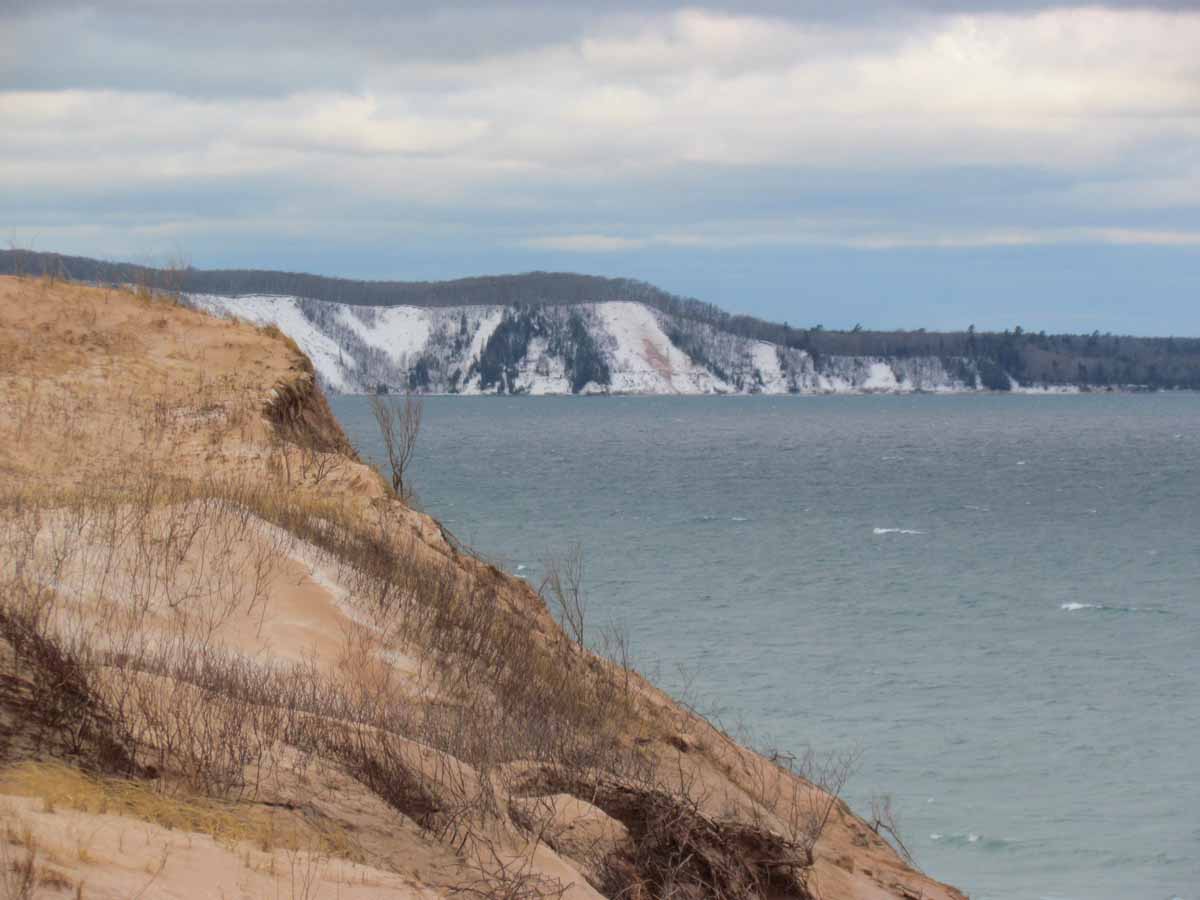
Wow. We had a blast! Last night four of my friends and I decided to go for a full moon snowshoe in the dunes. There is so little snow that we were able to drive to Sable Falls. We then headed on foot west down the trail, over the foot bridge, and into the dunes. We had seen the moon earlier, but as we entered the dunes there were a lot of clouds. Then, all of a sudden the clouds passed by.
The previous shot I took from the top of a dune. The photo below shows the result of getting down the frozen dune the safest way. Notice the full moon in the background.
The picture below I took of one of my friends who was standing on the top of a dune.
I decided to play with my new version of Photoshop. I combined the full frame moon shot with the previous picture.
Thanks to Dianna, Renee, Wendy, and Kim for a good time.
Monday, January 9, 2012
Sunday, January 8, 2012
How to Identify a Meteorite
On one of my trips down state while visiting my friend, Steve, in Mount Pleasant, he had a gathering with some of his friends. I ended up showing my "wowser" rocks to Matt and Helen Williams. Matt is a science teacher and wanted to see the rocks. The next day we received a call from the Wiliams. They wanted to meet with me to show me a rock.
The story about the rock is that several decades ago Helen's grandfather heard a loud noise outside his farm house. When he went out into his yard, there was a newly formed crater around ten feet deep with a small mound at the center. Steam or smoke was coming out of that mound. They decided to dig in that mound where the found the rock pictured below. The first shows shows Matt and Helen along with their daughter, Katey, and an exchange student staying with the family, Xlaashi Guo.
Here are some close ups of the rock.
Helen explained that the grandfather never had the rock examined because he was afraid that it would be taken away. They asked me to verify that it is a meteorite. I am an agate person and am not familiar with the details of meteorite identification. So yesterday I decided to do some Internet research. The best web page I found is: http://www.aerolite.org/found-a-meteorite.htm. In fact, from this web page there is an option to pay $10 to have them examine photographs of suspect rocks. Some of the facts they listed to help identify whether a rock is a meteorite are:
WHAT IS A METEORITE?A meteorite is a piece of iron, stone, or stony-iron composite that has fallen to Earth from outer space. Most meteorites originated within the Asteroid Belt between Mars and Jupiter, and were once part of a planet or large asteroid. A few meteorites come from the Moon and Mars, and a few others may possibly be fragments of cometary material. Meteorites are valuable both to science and the collecting community. Identification and classification of a new meteorite is a fairly complicated process that can only be handled by a very small number of specialists. |
SOME BASIC FACTS Meteorites are attracted to magnets Meteorites contain a great deal of extraterrestrial iron, even the ones that look like terrestrial rocks (stony meteorites). Just like a common nail or ball bearing, they will easily stick to a magnet.. Test your find with a good hardware store magnet, or a rare earth magnet .An extremely small percentage of meteorites (far less than one in a thousand) do not show strong attraction to a magnet. They are so rare that we usually discount anything that will not adhere to a magnet. Those meteorites look similar to volcanic rocks from Earth, and are not metallic in appearance. Meteorites are heavy Most meteorites are much denser than ordinary Earth rocks. The thing most people say when they hold a meteorite for the first time is, "Wow! It's so heavy!" The unusual weight is due to high iron content. Even stone meteorites will feel heavier in the hand than most Earth rocks. Meteorites are not radioactive Meteorites likely traveled in space for millions of years before visiting us here on Earth. They were bathed in cosmic rays, but are not dangerous or radioactive. Some meteorites, such as Canyon Diablo from Arizona, contain micro diamonds but those gems are nearly invisible to the naked eye and can only be seen after cutting a specimen. Meteorites do not contain emeralds, gold (except possibly as a trace element), fossilized aliens, or common earth minerals such as quartz. If your rock looks just like other earth rocks, it probably is one. Meteorites look and feel different from the ordinary rocks around them. Fusion crust Recently fallen meteorites will exhibit fusion crust. This is a thin black rind, sometimes shiny, sometimes matte black, which is acquired during burning in the atmosphere. A freshly fallen stone meteorite will look much like a charcoal briquette. Even stone meteorites that have been on the Earth for a long time usually retain some fusion crust and almost always appear much darker than ordinary rocks. Surface features Meteorites, especially irons, often acquire "regmaglypts" (thumbprints) caused when their surface melts during flight. Stone meteorites sometimes display regmaglypts too, but they are not as well defined as in irons. Meteorites, particularly irons, may also show angular features such as points and ridges, and also flow lines which are caused by melting. Many of the suspected meteor-wrongs we receive are common terrestrial volcanic rocks. Volcanic rocks (along with other types) often contain small, deep holes, as if they had been repeatedly punctured with a needle. These holes are called vesicles and are caused by gas escaping when lava cools. Meteorites do not contain vesicles. Below is a picture from the ID website that shows a rock that is not a meteorite. NOT A METEORITE This is a heavy rock which looks metallic but note the small holes caused by escaping gas. Meteorites do not have vesicles Metallic flakes Nearly all stone meteorites contain small, bright metallic flakes. These are tiny pieces of extra-terrestrial iron and nickel. You can usually see them after slicing off a small piece, or removing a corner with a bench grinder. Please note! We recommend that you do not cut up your suspected meteorite, or otherwise damage its appearance. A meteorite with a beautiful or interesting shape will be worth less to collectors if its end has been hacked off. Ask a meteorite professional or accredited lab to do your cutting and testing. Chondrules Small, colorful, grain-like spheres which occur in most stone meteorites, hence the name of these stone meteorites — chondrites. Chondrites are the most common type of meteorite. Chondrules Rust or patina Meteorites which have been on the Earth for a long time will likely start to rust, or — in dry desert environments — acquire a "patina" caused by oxidation. The natural patina of irons is often yellow/ochre, red, or orange. Temperature of recently fallen meteorite Despite what we see in Hollywood action movies meteorites are not burning, or even hot when they land upon the Earth. The glowing fireballs we see in the night sky are caused by atmospheric pressure and friction. Meteors stop ablating (burning) approximately seven miles above our planet's surface, then fall in what is known as "dark flight," according to the normal pull of gravity. It is very cold at an altitude of seven miles, so meteorites cool quickly as they plummet towards the Earth. There has never been a documented case of a burning, or even hot, meteorite landing upon the Earth. So despite the compelling story told by the Williams family, I am not sure if this is a meteorite. The last paragraph above suggests that meteorites are not hot when they land. If this is true, then there would not have been steam coming from the bottom of the crater. The web page also says that meteorites never have vesicle hole openings. You can see from the pictures of the Williams family specimen that it does have vesicles. But who knows -- maybe this specimen is an unusual rocky meteorite. It does have some of the "thumbprint" depressions on the surface and does have the orange/red color. We tried a magnet which didn't seem to stick to the rock, but we didn't use a high quality magnet sot his test was not conclusive. Through my friend, Steve, I sent a link to the meteorite ID website and suggested that they send photos of the specimen in for examination by experts. I would like to thank the Williams family for sharing their story. For their sake I hope that the specimen is a meteorite. |
Saturday, January 7, 2012
Beach Hike and Breakwall Photos
Yesterday it did not feel like winter. Temperatures were in the 40s so some of the very little bit of snow we have melted. Before exercising, I decided to go out to the end of Coast Guard Point and see what the break wall and lighthouse look like. Amazing. Most years the channel leading into the harbor would be completely iced in. This year -- no ice at all. Normally there would also be large ice formations on the break wall. This year -- the break wall is coated with ice, but there are no accumulations.
Snowmobiles are few in numbers. You can see it is difficult for them to find snow on which to ride.
No ice in the bay either.
Then I drove out to the School Forest and snowshoed the North Country Trail from the bridge to the shoreline. Once I reached the shore, I decided to walk west with intentions of heading up the bluff at the next access point located around a half mile down shore. It has been a few months since I have been to that access point so I didn't realize that the fall storms must have taken it out. All of the bluffs were vertical and too high to climb, so I kept walking west. First, here are a couple of pictures documenting what the beach looks like. A shot looking west....
A shot looking east....
As I proceeded west, I was amazed at some of the ice formations on driftwood.
The top layer of the dune bluff is frozen, and is collapsing at the bottom.
More ice formations....
Then I reached a section with absolute devastation. The power of Lake Superior is obvious. All of the trees taken out by the fall storms were approximately 70 feet tall and more. They were lined up on the bluff.
More ice...
There were also sections of the bluff that were absolutely vertical. You can see where the top sections crumbled. I knew that I had walked a lot farther west than I wanted. Finally I saw a place that I could possibly diagonally walk up the frozen bluff. At the top there was a ladder placed to allow you to get over the lip of the bluff. Since this location was in the middle of the woods, I figured the home owner would not be there. They were not. At first I wasn't sure exactly where I was, but there were snowmobile tracks. I followed the tracks back to the east and found the way back to my car.
Friday, January 6, 2012
Cross Country Ski and Sable Falls with Ice
Staff at the Pictured Rocks National Lakeshore groomed the cross country ski trails. However, the lack of snow resulted in twigs and grass showing through on some of the trail. With temperatures expected in the mid-30s today and next week, if we don't get more snow the trails will not be usable. But it was fun yesterday to be back on the groomed track!
The parking lot for the ski trails are across the street from the Grand Sable Visitor Center. Unfortunately, the center is not open in the winter.
When I skied past Sable Falls, I decided to take my skies off and carefully walk down the icy steps to see what the ice on Sable Falls looks like. This first shot shows the section just above the main part of the falls.
Here is a shot of the main part of the falls.
The entire falls.....
A close up of some of the icicles....
The ice formations in the river are cool, too.
I love the contrast between the vegetation and the snow.
Thursday, January 5, 2012
Great Sable Dunes Snowshoe
Yesterday it wasn't as cold with temperatures in the 20s and some sun in between the lake effect clouds. I parked at Sable Lake and snowshoed across the dunes to Lake Superior. Then I circled back to the west before returning to Sable Lake.
First a picture of Sable Lake showing the solid ice cover. As I left the parking lot and headed toward the dunes, I could see a very large animal about two miles down shore across the lake. It was too big to be a deer, so I'm guessing it was a moose. Unfortunately it was too far away and too quick for me to use the telephoto lens on my camera to get a better look or a photo.
As I was walking across the dunes, I spotted this flock of around 100 small birds feeding on seeds on the south side of a large dune.
This valley was very moon like.
I liked the contrast in color as well as the sharp ridges of this dune.
The clouds were quite dramatic as I approached the Lake Superior shoreline.
A shot looking east toward Grand Marais.
A close up of Coast Guard Point in Grand Marais.
A shot looking west toward Au Sable Point.
I liked the colors with dune grass, sand, and snow.
A long distance shot of the breakwall and lighthouse. Notice the waves splashing on the right side of the picture.
The sun was shining off the icy snow.
There were patches of sun throughout the area.
The banding pattern with layers of sand and snow looks like agate banding.
Subscribe to:
Posts (Atom)